
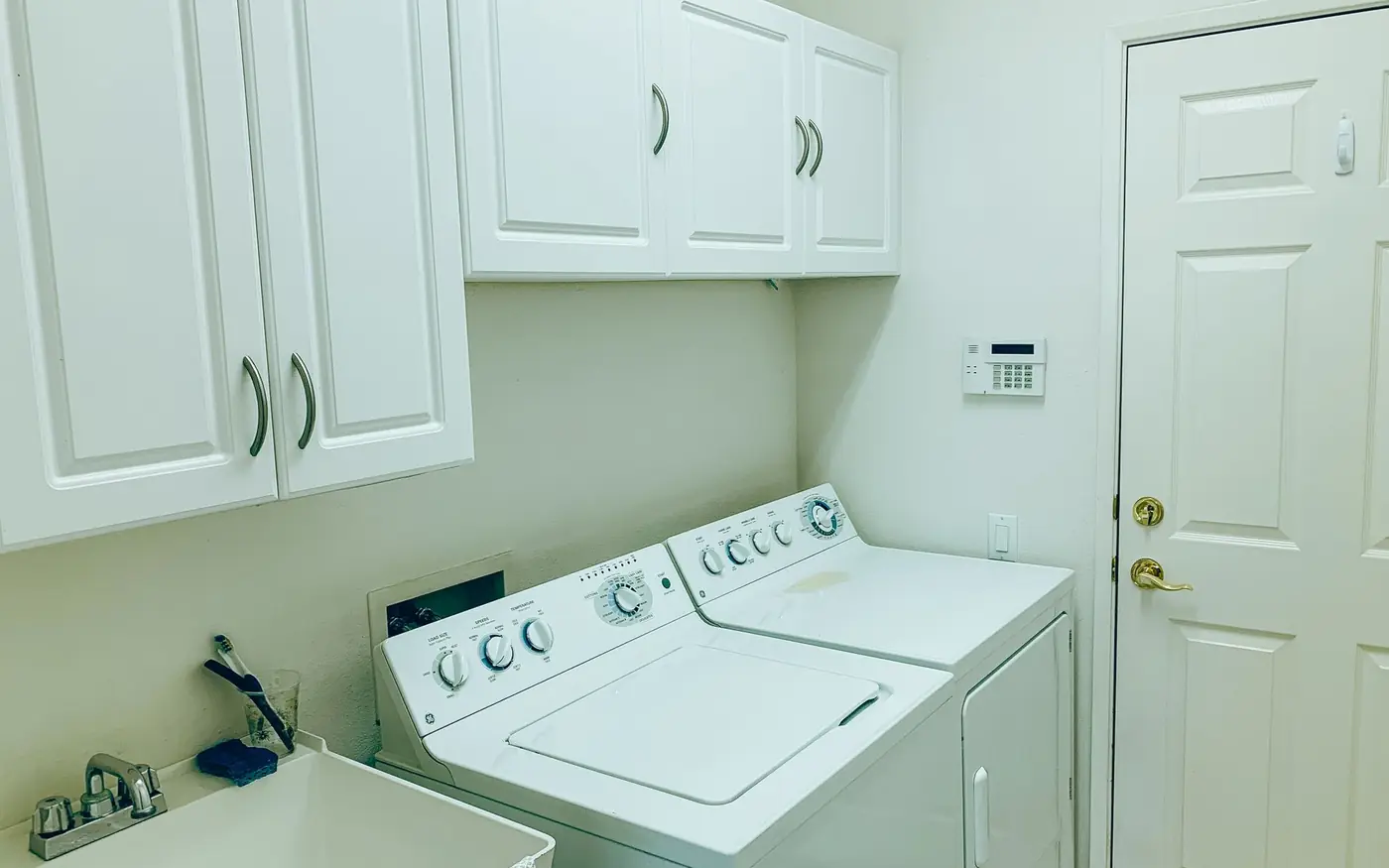
At a glance
Time: A weekend for most of these
Difficulty: Easy to moderate
You need: A tape measure before anything else
The problem with a narrow laundry room is that the machines take the floor, and everything else has to fit around them. You can’t make the room wider, so the answer is to stop using the floor for anything that could go on a wall.
Measure first. Write down the width of the room, the depth of each machine with its door open, and the height from the top of the machines to the ceiling. Every idea below depends on those three numbers.
Go up
Stack the machines. If you have front-loaders, a stacking kit from the same maker turns two footprints into one and frees half the room. Check that the models are approved for stacking and that someone in the house can reach the dryer controls.
Put a counter over side-by-side front-loaders. A plain board cut to fit, resting on wall cleats, gives you a folding surface where there was dead air. This doesn’t work with a top-loader, which needs its lid to open fully.
Shelve the wall above. One deep shelf at about eye level holds detergent and baskets. A second, higher shelf takes the things you use twice a year. Leave enough gap to lift a bottle out without tipping it.
Use the walls for drying
A wall-mounted rack that folds flat is the single most useful thing we’ve added to a narrow room. Accordion racks pull out a foot or more when needed and sit an inch from the wall when not.
A tension rod between two walls, or between a shelf bracket and the wall, gives you a place to hang shirts straight from the dryer. It costs a few dollars and needs no drilling.
For a ceiling over eight feet, a pulley rack that lowers on a cord keeps wet laundry above head height.
Fill the gaps
The space between the machines, or between a machine and the wall, is often four to eight inches wide. A slim rolling cart made for that gap holds detergent, stain remover and dryer balls, and pulls out like a drawer.
The back of the door takes an over-door rack or hooks for the ironing board, a mesh bag for delicates and the lint brush.
Change the door
A door that swings into a narrow room can block a third of it. Three options, from cheapest to most work: rehang it to swing outward, swap it for a curtain on a rod, or fit a sliding barn-style door on the hall side. A pocket door is the tidiest, and it’s a job for a carpenter.
Make it feel wider
- Paint the walls and shelves the same light color so the edges blur.
- Add a light. Many laundry rooms have one dim ceiling bulb. A plug-in strip under the shelf puts light where you check for stains.
- Keep the floor clear. One hamper that fits under the counter beats three that don’t.
What to leave room for
Machines need air and access. Leave about an inch at each side and four to six inches behind for hoses and the dryer vent, and don’t crush the vent hose to gain depth: a kinked vent slows drying and collects lint.
You need to stand in front of an open door and bend down. If the walkway in front of the machines drops much below three feet, loading gets awkward fast.
And keep the water shutoff valves reachable. Whatever goes on that wall should lift off or swing aside in a hurry.
If you rent
Tension rods, over-door racks, rolling carts and freestanding shelves over the machines all come with you when you leave. That’s most of the benefit without a single hole in the wall.